Floodplain Info
Learn More

Sign up for Everbridge, the Town’s Emergency Notification System, to receive emergency texts and emails, and the Town's Monthly Newsletter to stay up to date on all of Town's meetings, projects and special events.
Stormwater project update map between Station 27 and Station 32.
Re-paving work will be taking place through next week in the areas of Station 30 to 31 between Middle Street and Brownell Avenue.

Walk alongside towering palmetto log walls. Learn how the 1776 fort was constructed. Discover the Battle of Sullivan's Island. Explore how South Carolina's palmetto legacy was born. The fort that defeated the British Fleet and shaped a nation. Visit the living exhibit on the Mound at Battery Capron, 2056 middle Street above Stith Park. Parking may be found along Middle Street and at Battery Thompson, behind the Sullivan's Island Post Office.
We hope you enjoy your visit to this self guided experience. Hours of operation are 8:00am-5:00pm. Waste disposal is to leave no trace. Pack it in, pack it out. Pets must be leashed and you must clean up your pet waste. Please do not climb on the exhibit. If you have an emergency please dial 9-1-1! For police non emergency please dial 843-743-7200.
2026 marks the 250th anniversary of the United States of America’s Independence. Our Town played a crucial role during the Battle of Sullivan’s Island by defeating the British Royal Navy. This early battle was pivotal in the fight for freedom and protecting Charleston and the Lowcountry from a British invasion. This impactful defeat of the British helped secure freedom for America.
On January 20, 2026 Brett Bennett with SC250 gave a presentation to Town Council regarding the proposed partial reproduction of the palmetto log fort. To view the full presentation please click here.
Access Map

Parking for the Palmetto Log Fort Exhibit
Visitors to the Palmetto Log Fort Exhibit have several convenient free parking options available. We encourage visitors to use these public parking areas and enjoy a short walk to the exhibit while exploring the historic surroundings of Sullivan's Island:
1. Town Hall Parking
Located behind Sullivan's Island Town Hall, this gravel lot offers 15 free parking spaces, including four ADA-accessible spaces. Please do not park in spaces reserved for the Police Department or Town Hall staff. In addition, two ADA-accessible spaces are available atop the mound on a first-come, first-served basis.
2. On-Street Parking
Numerous free on-street parking spaces are available within a short walking distance of the exhibit along Middle Street, Central Avenue, Gull Drive, and surrounding streets. Please observe all posted parking regulations.
3. Battery Thompson
Located just a short walk from the exhibit, Battery Thompson provides approximately 50 free parking spaces, including two ADA-accessible spaces and three designated golf cart parking spaces.
4. Battery Gadsden
Battery Gadsden offers approximately 25 free parking spaces and two designated golf cart parking spaces. Visitors are asked not to park in spaces reserved for the Poe Library.
Carolina Day Turns 250: The Battle of Sullivan's Island
A note from your neighbors at Fort Moultrie
Submitted by Brad Shattuck
Superintendent- Fort Sumter & Fort Moultrie National Historical Park
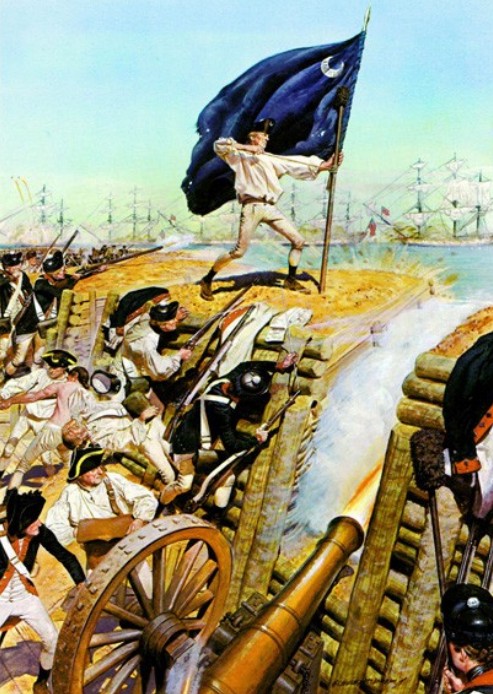
On June 28, 1776, a small band of Patriot defenders — under the command of Colonel William Moultrie — stood inside a half-finished fort of palmetto logs and sand on the south end of our island and did something the world thought impossible: they turned back one of the most powerful navies on earth. Cannonballs from the British fleet sank harmlessly into the spongy palmetto walls, and after a day-long bombardment the Royal Navy withdrew. It was one of the first decisive American victories of the Revolution. It gave South Carolina its enduring symbol — the palmetto tree that still flies on our state flag — and it gave the fort the name it carries today.
That name honors Colonel Moultrie himself, who is reverently buried near the fort he defended. The blue-and-white Moultrie Flag he raised over these walls 250 years ago still flies above them today. South Carolinians have honored the anniversary as “Carolina Day” ever since.
What it Means for Residents
This is your island and your fort, and we want you there. Events are free and open to the public. To keep things moving, we'll run a two-line shuttle system, a Red Line from Lucy Bekham and a Blue Line from Mount Pleasant Town Hall, including a stop at Town Hall, where you can see the replica palmetto fort up close.
We know a celebration of this scale brings extra visitors, and we're grateful in advance for your patience and partnership as we welcome guests from across the country to a place you call home. Whether your family has been on Sullivan's Island for generations or you arrived last week, Carolina Day belongs to all of us. We hope you'll come stand with us at the fort.
Introduction:
The citizens of Sullivan's Island live on hallowed ground in terms of American history. The southern colonies were vulnerable in 1776. Had the British been successful in taking Sullivan’s Island, they arguably would have controlled the richest city and its invaluable harbor. A signal would have been sent to the significant Loyalist and independent populations in the Carolina's and Georgia that British rule would prevail. Patriots were a minority at the time. The loss of Charles Town in 1780 is considered the biggest defeat of the American Revolution. What would it have meant if Charles Town fell in 1776? The stunning victory was a huge confidence boost to go along with the announcement of the Declaration of Independence. We started winning that independence right here on Sullivan’s Island on June 28, 1776. The fort replica is an excellent tool to educate and communicate that to all residents.
Exhibit Description:
Soon residents and visitors to Sullivan’s Island will be able to look up behind the town park and see atop a looming hill an intriguing and educational structure. Visible from Middle Street will be a replica of a section of the palmetto log fort that played such a critical role in the Battle of Sullivan’s Island on June 28th, 1776. This will be the culmination of a project that began in 2024. The concept was stimulated by the previous recreation of a section of the old fort’s wall in 1976 for the Bicentennial. That was carried out by the National Park Service on the grounds of Fort Moultrie. For multiple reasons the fort grounds could not be used for the current project, so a search began for another location on the island. Several spots were considered but each had its drawbacks. Finally, the location on top of the Mound was approved by the Town Council. In contrast to 1976, for the 250th celebration this small section of the palmetto fort wall will be built using modern materials that replicate the appearance of the 1776 fort, but will be safer, less expensive and easier to build. Crowning the parapet will be two replica cannons appearing to stand guard over the town hall and town park. There will be a fence surrounding the exhibit to prevent visitors from climbing on it, but there will be educational panels placed explaining the history and significance of the original fort, named Fort Moultrie soon after the battle. The Town of Sullivan’s Island will add new pedestrian access along the current driveway, two ADA accessible parking spots for those who cannot climb the hill, low voltage lighting for nighttime illumination and security cameras. The exhibit is a project of SC250 Charleston and is funded by SC250, the state organizing committee.
But why a replica palmetto log fort on Sullivan’s Island?
By the end of 1775 South Carolina had run out the last royal governor of the colony, Lord William Campbell. But through various intelligence sources, the newly independent state had found out that a large contingent of both British army forces and naval forces were headed for Charles Town, as it was then known, to reestablish crown rule. In January of 1776, the local Council of Safety authorized the building of a fortification on Sullivan’s Island, which was felt to control the entrance to the harbor. In March of 1776 Col. William Moultrie was ordered to the island to supervise the building of that fortification. He found already at work about a thousand laborers, many of them enslaved workers borrowed from surrounding plantations. What was that fort constructed of? Thousands of logs from the local palmetto tree and sand. Who decided on this method of construction? The answer to that is lost to history. The fort to be built was huge, about 500 feet on each of its four sides, designed to accommodate about 1000 troops. The British forces arrived in the area in May of 1776. The army contingent landed on Long Island, today’s Isle of Palms. The naval forces, including 9 powerful warships anchored in front of Morris Island to the south, an area known as Five Fathom Hole. On the day of the battle, June 28th, 1776, the British troops were supposed to attack across Breach Inlet at the north end of Sullivan’s Island. However, partly due to faulty intelligence they were defeated by Col. William Thomson. The details of that part of the battle are told in today’s Thomson Park, adjacent to Breach Inlet on Sullivan’s Island. Visitors are encouraged to visit that site. The palmetto log fort part of the story took place at the site of today’s Fort Moultrie, part of the Fort Sumter-Fort Moultrie National Historical Park. The four most powerful British ships, with about 150 guns, anchored 400 yards off the beach with broadsides aimed directly at the fort. There were other British ships that played a role in the battle, but these four took on the palmetto log fort directly. As the battle progressed the British unleashed between 10,000 and 12,000 rounds of cannon fire while the Patriots countered with only 30 guns in the palmetto log fort firing less that 1000 rounds. However, the effect of those 1000 rounds was devastating for the British fleet, while the 10,000 shots from the British fleet were essentially ineffective. Why was that? The palmetto log is very spongy and resilient. Between that and the sand that filled the space between two rows of logs 16 feet apart, the British cannon balls were seen to simply bounce off the sides of the wall. What an incredibly fortunate way of building a fort based only on the materials at hand. The outcome? The British were defeated on June 28th, a date we now recall each year as Carolina Day. And while they did return and capture Charles Town in 1780, the story of the palmetto log fort lives on.
The palmetto tree was added to the South Carolina flag in 1861, and the state bears the nickname, the Palmetto State. The state seal and the seal of the Town of Sullivan’s Island both include images of the palmetto tree. It seems fitting then that Sullivan’s Island will be home to a small recreation of the palmetto log fort as part of its celebration of our nation's 250th anniversary.